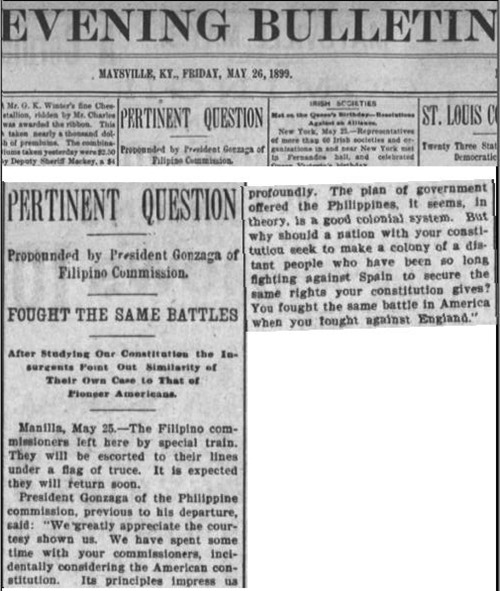

In May 1899, amid the escalating conflict between Filipino revolutionaries and American forces, both sides sought a resolution through diplomacy. As the Philippine army struggled to repel the advancing U.S. military, President Emilio Aguinaldo established a peace commission to negotiate an armistice. This led to a historic meeting between Filipino leaders, headed by the young General Gregorio del Pilar, and the American Schurman Commission. The outcome of these negotiations would have far-reaching consequences, shaping the future of the Philippines in its fight for independence.
May 19-23, 1899: Negotiations Between Filipino and American Peace Commissions

In the late 19th century, as the Philippines grappled with the onset of American colonization, the conflict between Filipino revolutionaries and American forces intensified. By May 1899, the Philippine army found itself unable to halt the advancing American military, leading President Emilio Aguinaldo to consider diplomacy as a means to halt the bloodshed. In a significant move, Aguinaldo established a peace commission tasked with negotiating an armistice with the United States.
This peace commission, formed in the shadow of defeat, was led by the young and dynamic 23-year-old General Gregorio del Pilar, who had already made a name for himself as a brave and strategic leader during the Philippine Revolution against Spain. Joining him were Captain Lorenzo Zialcita, Alberto Barretto, and Gracio Gonzaga, each bringing their unique perspectives and dedication to the Filipino cause.
The Anaconda Standard, Anaconda, Montana, issue of Aug. 29, 1899, page 15.
With the Philippine army unable to contain the American offensive, President Emilio Aguinaldo created a peace commission to negotiate an armistice. He appointed 23-year-old General Gregorio del Pilar to head the Filipino panel, with Captain Lorenzo Zialcita, Alberto Barretto and Gracio Gonzaga as members.
The Schurman Commission: America’s Terms of Peace
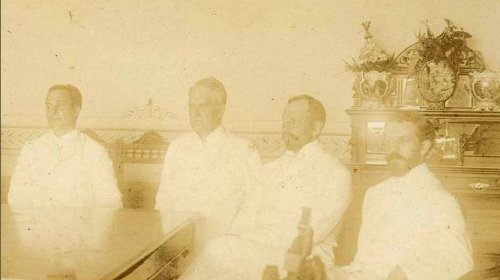
On the American side, the peace commission was known as the Schurman Commission, named after its chairman, Jacob Schurman. The commission’s primary purpose was to establish U.S. sovereignty over the Philippines, which had been ceded to the United States by Spain after the Treaty of Paris in December 1898. The other members of the commission included Charles Denby, a former U.S. Minister to China; Dean C. Worcester, a zoologist with extensive knowledge of the Philippines; and John MacArthur, who served as the secretary. Together, they represented the American government’s firm stance on its new colonial acquisition.
The two sides met on May 19-20, 1899, in what became a pivotal moment in Filipino-American relations. Despite the efforts of del Pilar and his team, the Schurman Commission remained steadfast in its demands. They insisted on the recognition of U.S. sovereignty over the entire archipelago, a condition that the Filipino negotiators understood to mean the unconditional surrender of their army. The refusal to consider an armistice without these terms was a clear indication of the United States’ intention to fully subjugate the Filipino forces.
The Aftermath: Aguinaldo’s Unyielding Resolve
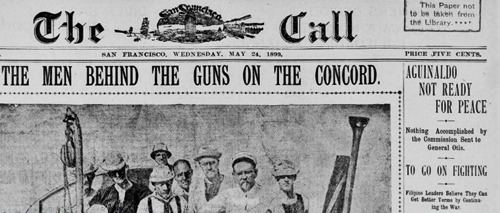
Despite the efforts of his peace commission, President Aguinaldo was not ready to accept the terms laid out by the Americans. On May 24, 1899, just two days after the negotiations ended, the San Francisco Chronicle reported Aguinaldo’s firm stance against peace under the conditions offered by the U.S. He believed that accepting such terms would betray the struggle and sacrifice of the Filipino people who had fought for independence first against Spain and now against a new colonial power.
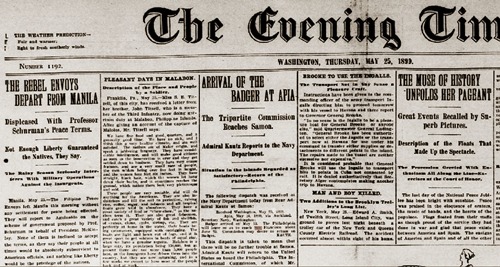
The failure of the negotiations had immediate and severe consequences. The Filipino envoys, having failed to secure an armistice, departed Manila on May 25, 1899, returning to a nation still engulfed in war. The Evening Times reported on their departure, signaling the end of any hope for a peaceful resolution at that time.
Pedro Paterno’s Call to Arms
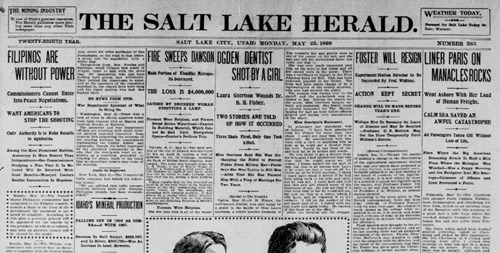
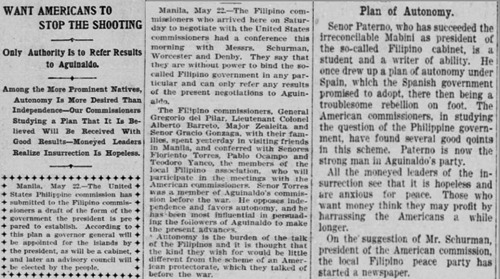
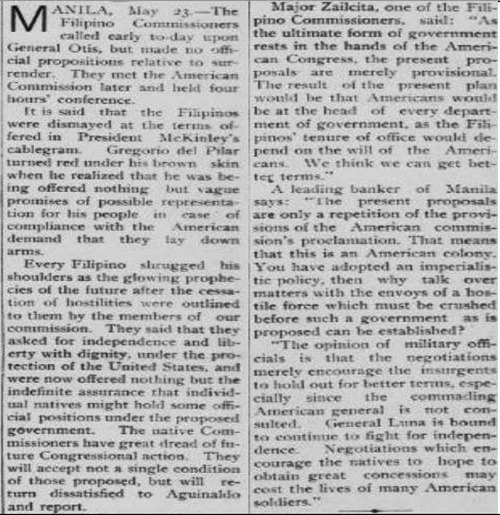
In the days following the failed negotiations, the mood among Filipino leaders turned from cautious optimism to a renewed call for resistance. On June 2, 1899, Pedro Paterno, the head of Aguinaldo’s cabinet and a former advocate of peace with the Americans, issued a manifesto to the Filipino people. In this document, he acknowledged the futility of further peace efforts and urged all Filipinos to continue the struggle against American forces. His words, “To war, then, beloved brothers, to war,” echoed the sentiment of a nation unwilling to surrender its fight for independence.
The Schurman Commission’s Legacy
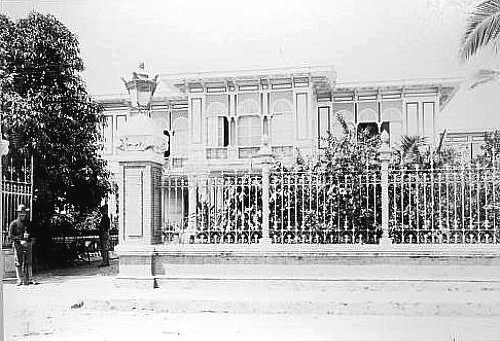
Despite the failure of the peace talks, the Schurman Commission continued its work in the Philippines. The commission’s efforts culminated in the establishment of civil governance under American rule, laying the groundwork for the eventual integration of the Philippines into the American sphere of influence. The commission’s headquarters, located in the Malate district of Manila, became a symbol of the new colonial authority. Photographs from around 1900-1902 depict the house occupied by the U.S. First Philippine Commission, capturing the contrast between the grandiosity of American power and the persistent struggle of the Filipino people.
In retrospect, the events of May 1899 represent a critical juncture in the Philippine-American War. The failed negotiations underscore the deep-rooted tensions between the desire for independence and the imposition of foreign rule. While the Schurman Commission’s insistence on U.S. sovereignty set the stage for the eventual pacification of the Philippines, the unwavering resolve of Filipino leaders like Aguinaldo and Paterno highlighted the enduring spirit of resistance that would shape the nation’s history for years to come.