

In Norse mythology, few weapons are as legendary as Gram, the sword wielded by Sigurd, the hero of the Volsunga Saga. This mythical blade is not only famous for slaying the fearsome dragon Fafnir but also carries with it a deep and storied history that intertwines with the fates of gods and men.
What is the Gram Sword?
The sword Gram is a central element in several Germanic and Norse sagas, most notably in the Volsunga Saga, a 13th-century epic that chronicles the rise and fall of the Volsung clan. The sword’s reputation is largely built on its role in the tale of Sigurd, who uses it to kill Fafnir, a dragon transformed from a greedy dwarf, thus claiming the creature’s vast treasure hoard.
Interestingly, the sword Gram appears under different names in various legends, highlighting its wide-reaching influence across mythologies. In the Thidrekssaga, it is wielded by the hero Hildebrand. In the German epic poem Nibelungenlied (The Song of the Nibelungs), it is known as Balmung, and in Richard Wagner’s opera cycle Der Ring des Nibelungen (The Ring of the Nibelung), it is referred to as Nothung. These different names underscore the sword’s importance across multiple tales, each adapting the story of the powerful blade to fit its own narrative.
Key Facts About the Gram Sword
- Odin’s Gift: Gram was originally given to Sigmund, Sigurd’s father, by the god Odin. Odin, disguised as a mysterious stranger, thrust the sword into the trunk of the great tree Barnstokkr during a wedding feast. Only Sigmund was able to pull it out, signifying his divine favor.
- Reforging: After being broken in battle by Odin himself, the sword was later reforged by the dwarven smith Regin from the shards of the original blade. Sigurd presented these pieces to Regin, who created an even more powerful sword from them.
- Fafnir’s Bane: Gram is most famous for being the weapon that Sigurd used to slay the dragon Fafnir. Sigurd drove the sword into Fafnir’s heart, killing the dragon and claiming its treasure, including the cursed ring Andvari’s ring.
- Symbol of Heroism: The sword is often seen as a symbol of heroism and the divine right of the Volsung lineage. It represents not only physical strength but also the courage and destiny of those who wield it.
- Multiple Names: Gram is known by several names in different versions of the myth. In the Nibelungenlied, the sword is called Balmung, while in Wagner’s Der Ring des Nibelungen, it is referred to as Nothung.
- Sigurd’s Final Rest: After Sigurd’s death, Gram was placed between him and Brynhild on their shared funeral pyre, symbolizing the hero’s honor in death. This act also marked the end of Gram’s recorded history in the sagas.
- Mythological Importance: The story of Gram is intertwined with the fates of gods and heroes in Norse mythology. The sword’s connection to Odin, its role in slaying Fafnir, and its association with the Volsung line make it one of the most significant weapons in mythic lore.
- Cultural Influence: Gram’s story has influenced various retellings and adaptations in literature and art, most notably in Germanic myths and Wagnerian opera. The sword’s legacy continues to be a symbol of heroic destiny and divine intervention in epic tales.
What Does the Sword Gram Look Like?
Descriptions of Gram are as elusive as they are legendary. The Volsunga Saga provides little in the way of specifics regarding the sword’s appearance, leaving much to the imagination. However, the text hints at its grandeur, with some interpretations suggesting that it gleamed brightly and was adorned with gold, befitting a weapon of divine origin. Some accounts even propose that the sword may have borne a dragon symbol, a fitting emblem for the weapon that would one day slay the mighty Fafnir.
The Origin of the Gram Sword
The origins of Gram are as mysterious as the sword itself. Before it came into the possession of Sigurd, the sword was owned by his father, Sigmund, a hero in his own right. The tale of how Sigmund acquired Gram is steeped in the mystique of the gods.
During the wedding feast of Signy, Sigmund’s sister, a mysterious stranger appeared. This stranger, later revealed to be Odin—the Allfather and chief of the Norse gods—thrust the sword into the trunk of a great tree called Barnstokkr, which stood in the center of King Volsung’s hall. Odin declared that only the one who could pull the sword from the tree would have the right to wield it. Many tried and failed, but when Sigmund approached, he drew the sword effortlessly, revealing his divine favor.
King Siggeir, who coveted the sword, offered Sigmund a vast amount of gold in exchange for it. When Sigmund refused, Siggeir’s envy turned to rage, leading to a series of tragic events. Siggeir eventually killed Sigmund’s father and captured him and his brothers. The sword Gram, symbolizing Sigmund’s right to vengeance, temporarily disappeared from the saga, only to reemerge later as a beacon of hope.
In a dramatic twist, Sigmund’s sister Signy secretly returned the sword to him while he was imprisoned. Using Gram, Sigmund and his son Sinfjotli exacted their revenge on King Siggeir. However, the sword’s journey did not end there. During a battle against King Lyngvi, Odin intervened once again, breaking the sword in half and signaling that Sigmund’s time was coming to an end. Before he died, Sigmund entrusted the broken pieces of the sword to his wife, Hjordis, who kept them safe for their son, Sigurd.
Sigurd and the Gram Sword
Sigurd’s tale is where the legend of Gram truly comes to life. Raised by his mother Hjordis, Sigurd eventually came under the tutelage of Regin, a dwarven smith who taught him the arts of combat, runes, and languages. Regin also told Sigurd of the great treasure guarded by Fafnir, a dragon who was once Regin’s brother before being transformed by greed.
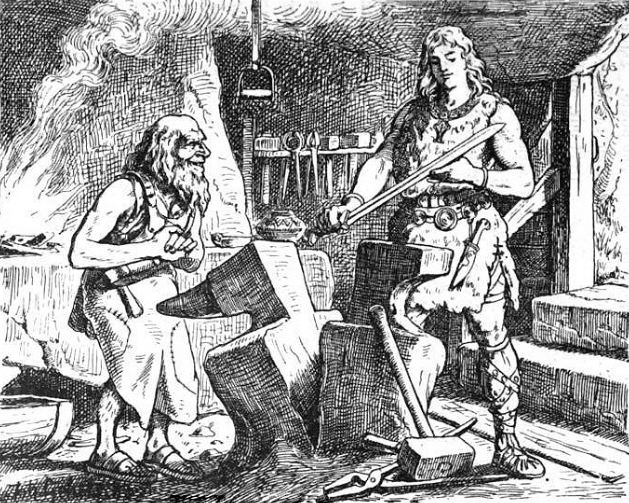
Regin urged Sigurd to slay the dragon and claim the treasure. Sigurd agreed, but only if Regin could forge him a sword mighty enough to kill the dragon. Twice Regin tried, and twice his swords broke. Finally, Sigurd presented Regin with the shards of his father’s sword, Gram, asking the dwarf to reforge it. This time, Regin succeeded in crafting a sword of unparalleled strength and sharpness.
To test Gram, Sigurd struck an anvil and split it in two, proving the sword’s might. Armed with this legendary blade, Sigurd avenged his father by killing King Lyngvi. However, his most famous deed was yet to come.
In a climactic battle, Sigurd confronted Fafnir. Using Gram, he delivered a single, powerful thrust to the dragon’s left shoulder, mortally wounding the beast and ending its reign of terror. This victory cemented Sigurd’s place in legend as one of the greatest heroes of Norse mythology.
Key Facts About Sigurd
- Sigurd’s Lineage: Sigurd, also known as Siegfried in Germanic legends, is a prominent hero in Norse mythology. He is a member of the Volsung clan, a royal lineage with ties to the gods. His father was Sigmund, a hero who wielded the sword Gram, and his mother was Hjordis.
- Slayer of Fafnir: Sigurd is most famous for slaying the dragon Fafnir. Fafnir was originally a dwarf who turned into a dragon to guard his vast treasure. Sigurd killed the dragon by stabbing it in the heart with Gram, an act that made him a legendary hero.
- Regin’s Role: Sigurd was mentored by Regin, a dwarven smith, who taught him the ways of combat and encouraged him to kill Fafnir. Regin was actually Fafnir’s brother and sought to use Sigurd to reclaim the treasure.
- Taste of Dragon’s Blood: After killing Fafnir, Sigurd accidentally tasted the dragon’s blood, which gave him the ability to understand the language of birds. This newfound ability helped him discover that Regin planned to betray him, leading Sigurd to kill Regin instead.
- Sigurd and Brynhild: Sigurd’s love story with Brynhild, a Valkyrie, is one of the most tragic in Norse mythology. They swore eternal love to each other, but through a series of betrayals and misunderstandings, their love ended in tragedy, with both meeting untimely deaths.
- Sigurd’s Death: Sigurd was eventually betrayed and murdered by Gunnar, a king who was manipulated by his wife, Gudrun. Brynhild, in her grief, threw herself onto Sigurd’s funeral pyre, joining him in death.
- The Nibelungenlied: In the Germanic epic Nibelungenlied, Sigurd is known as Siegfried. The story shares similarities with Norse legends but also introduces unique elements, such as Siegfried’s invulnerability except for a single spot on his back where a linden leaf had fallen while he bathed in dragon’s blood.
- Legacy: Sigurd’s legend has influenced many later works, including Richard Wagner’s opera cycle Der Ring des Nibelungen, where he is portrayed as a central figure in the epic tale of gods, heroes, and a cursed ring.
- Cultural Impact: Sigurd’s story is one of the most enduring in Norse mythology, symbolizing themes of bravery, betrayal, and the tragic nature of heroism. His tale has been retold in various forms across different cultures, cementing his status as an archetypal hero in European folklore.
The Final Chapter of Gram
Sigurd’s life, like that of many heroes, ended tragically. After being betrayed and killed by those he once trusted, Sigurd was laid to rest alongside Brynhild, the Valkyrie who had loved him. In a final act of honor, Gram was placed between them on the funeral pyre, a symbol of the hero’s indomitable spirit and the tragic end of his saga.
With Sigurd’s death, the story of Gram also fades from the pages of history. The sword, once a symbol of divine favor and heroic destiny, passes into legend, its ultimate fate unknown. Yet, the legacy of Gram endures, a testament to the enduring power of myth and the timeless tales of courage, betrayal, and destiny that continue to captivate us.