

The Filipino-American War began in 1899, soon after the Philippines declared independence from Spain. For over 300 years, Spain ruled the Philippines and set up its own legal system in the country. Spanish courts and laws were used to manage local issues and conflicts.
When the war started, Spain had just lost control of the Philippines to the United States. However, the Spanish courts still played a role in the early stages of the war. This article looks at how the Spanish legal system affected the conflict and how it changed as American rule took over.
Background of Spanish Courts in the Philippines
During the Spanish colonial period, which lasted from the 16th century until the late 19th century, Spain introduced its legal system to the Philippines. This system was built to manage the colony’s governance, disputes, and administration of justice. It was based on Spanish laws and practices and reflected the hierarchical structure of Spanish society.
Overview of the Spanish Colonial Legal System in the Philippines (16th Century to Late 19th Century)
The Spanish legal system in the Philippines was organized to ensure that Spanish colonial interests were maintained while keeping order among the local population. Spanish law, which had been developed over centuries, was adapted to the needs of the colony. It aimed to manage civil and criminal cases, land disputes, and conflicts among different social classes, including Spanish settlers, indigenous people, and mestizos.
Structure of the Courts: Audiencia Real, Lower Courts, and Local Judicial Systems
The highest court in the Spanish colonial Philippines was the Audiencia Real, established in Manila in 1583. This court acted as the supreme authority in legal matters and handled serious civil and criminal cases. It was also the final court of appeal for lower court decisions.
Beneath the Audiencia Real were the lower courts, which dealt with more localized issues. These included provincial and municipal courts that handled disputes involving land, trade, and smaller crimes. Local Spanish officials often presided over these courts, although sometimes indigenous leaders were also given minor judicial roles, particularly in villages or barangays.
At the grassroots level, there were local judicial systems that operated in towns and rural areas. These systems were usually led by Spanish priests or officials, but local leaders could also help resolve minor disputes. However, justice in these lower courts was often biased towards Spanish interests.
Influence of Spanish Laws, Including Código Penal and Las Siete Partidas
Two key legal documents influenced the Spanish legal system in the Philippines. The Código Penal was the Spanish criminal code introduced in the Philippines in the 19th century. It outlined punishments for crimes ranging from theft to rebellion and established the rules for criminal procedures. This code applied to both Spaniards and Filipinos, though there were differences in how justice was administered depending on a person’s social status.
Another significant legal text was Las Siete Partidas, a collection of laws dating back to medieval Spain. Although ancient by the 19th century, parts of this law continued to influence legal judgments in the Philippines, particularly in civil matters like property disputes, inheritance, and family law.
These Spanish laws formed the backbone of the legal system in the Philippines for centuries, and their influence continued even as American control replaced Spanish rule at the end of the 19th century.
Legal Challenges During the Filipino-American War
The Filipino-American War (1899–1902) posed significant legal challenges as the Philippines transitioned from Spanish to American rule. The shift in power brought changes to the legal system, but Spanish courts still played a role in the early stages of the war.
Transition from Spanish to American Rule After the Spanish-American War (1898)
The Treaty of Paris, signed in December 1898, officially ended the Spanish-American War and transferred control of the Philippines from Spain to the United States. This marked the end of over 300 years of Spanish rule in the Philippines. However, the transition was not immediate, and the Spanish legal system continued to operate briefly as the Americans established their own government.
During this transition, American authorities initially retained many aspects of the Spanish legal system to maintain order, as creating a completely new legal structure would take time. Spanish courts continued to function, especially in more remote areas, until American courts and legal procedures could be put in place.
Role of the Spanish Courts in the Early Stages of the Filipino-American War
In the early stages of the Filipino-American War, Spanish courts still played an important role in administering justice. Although the United States had begun establishing its authority, the Spanish legal system was more familiar to both the colonizers and the local population.
Spanish courts dealt with civil disputes, property claims, and minor criminal cases. However, they also had to handle the growing unrest as Filipino revolutionaries resisted American rule. The courts became a key battleground in maintaining colonial control, and legal proceedings often reflected the tensions of the ongoing conflict.
Treatment of Filipino Revolutionaries and Legal Procedures Under Spanish Courts
As the revolution against both Spanish and American colonization grew, Filipino revolutionaries were often arrested and brought to trial under the Spanish courts. These courts followed procedures outlined in Spanish law, which typically favored colonial interests. Revolutionaries were charged with crimes like sedition, rebellion, and treason.
Legal procedures were harsh, with many revolutionaries receiving swift and severe sentences, often without fair trials. Torture and intimidation were sometimes used to extract confessions. The Spanish courts treated most revolutionaries as criminals rather than as political dissidents, leading to executions, long prison sentences, or exile.
Despite this, some Filipino leaders managed to use the courts as a platform to voice their demands for independence. The legal resistance by Filipino revolutionaries highlighted the limitations of the Spanish legal system in dealing with growing nationalist sentiments.
The Shift to American Legal Control

Following the Treaty of Paris in 1898, the Philippines was ceded by Spain to the United States, which marked the beginning of a new era in the legal system. The transition from Spanish to American rule wasn’t immediate, and the shift brought significant changes to the country’s legal proceedings.
The Handover of Spanish Courts to American Control Post-Treaty of Paris (1898)
The Treaty of Paris officially ended the Spanish-American War and resulted in the transfer of control over the Philippines from Spain to the United States. With this handover, the American authorities took control of the existing Spanish legal institutions. Initially, the U.S. allowed the Spanish courts to continue functioning to maintain stability and order while they worked to establish their own legal infrastructure.
During this period, American officials began to assess the existing judicial system. While they aimed to preserve certain aspects of Spanish law to avoid a complete overhaul, it became clear that significant changes were necessary to align the legal framework with American ideals of governance. This period of legal duality saw American military and civil authorities taking over more control, gradually diminishing the role of Spanish courts.
Changes in Legal Proceedings as the U.S. Established Its Authority
As the U.S. established its authority in the Philippines, the legal system underwent a transformation. One of the major shifts was the introduction of American legal principles, which prioritized individual rights, the rule of law, and due process, concepts that were sometimes inconsistent with the colonial Spanish system.
Key changes included:
- Abolition of Spanish colonial courts: Gradually, Spanish courts were dismantled and replaced by American-style courts. Military courts initially handled many cases, especially during the war, but civilian courts were later established to deal with everyday legal matters.
- Introduction of American legal codes: U.S. authorities introduced American legal codes and systems to replace Spanish laws. This included the implementation of U.S. civil and criminal laws, which were foreign to the Filipinos, but more in line with American practices of justice and legal governance.
- Greater focus on due process: The American system placed a stronger emphasis on formal legal proceedings, ensuring that accused individuals had the right to a fair trial, legal representation, and the presumption of innocence.
General Otis Reinstates Spanish-Legacy Courts of Law, May 29, 1899

On June 5, 1899, an oath-taking ceremony was held for the reinstatement of Spanish-legacy courts in the Philippines. Among those standing were notable Filipino legal figures: Manuel Araullo, Florentino Torres, Gregorio Araneta, and Cayetano Arellano, alongside Captain William E. Birkhimer. Seated were Colonel Enoch H. Crowder, who administered the oath, and Major Richard W. Young.
Before the American invasion, the highest judicial authority overseeing the Philippines was the Supreme Court of Spain, based in Madrid. Locally, the Audiencia Territorial de Manila, with its two branches—Sala de lo Civil and Sala de lo Criminal—served as the top court for civil and criminal cases.
After the fall of Manila to American forces on August 13, 1898, General Wesley Merritt, the Commanding General of the 8th U.S. Army Corps and military governor of the Philippines, suspended the criminal jurisdiction of the Audiencia Territorial. In its place, he established military commissions, court-martials, and provost courts to handle legal matters.

On May 29, 1899, Merritt’s successor, Major General Elwell S. Otis, consulted with Cayetano Arellano, a Filipino lawyer who had collaborated with both the American and Aguinaldo governments. General Otis then re-established the Audiencia Territorial under new general orders.
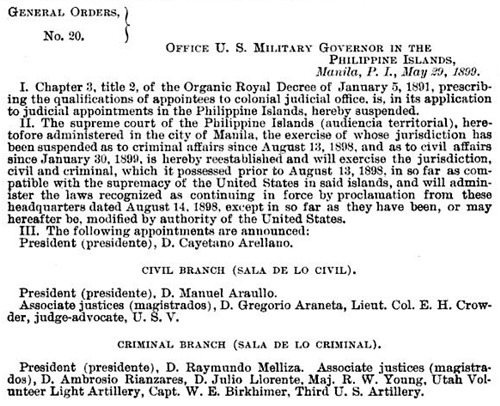
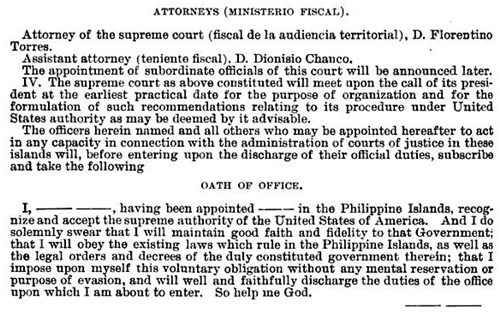

These orders granted the Audiencia Territorial de Manila jurisdiction over civil and criminal cases, but only to the extent that they aligned with U.S. sovereignty.
The modern Supreme Court of the Philippines, however, traces its origins to June 11, 1901, when Act No. 136 of the Second Philippine Commission granted the court true judicial independence. This judicial structure was further solidified with the passage of the Philippine Bill of 1902 by the U.S. Congress.
The Role of the New U.S.-Backed Legal System During the War
The U.S.-backed legal system played a critical role during the Filipino-American War, as it helped solidify American control over the islands. Military courts were used to try Filipino revolutionaries and those accused of aiding the rebellion. These trials often resulted in severe penalties, including executions and long prison sentences.
At the same time, the new legal system was promoted as a sign of American progress and fairness, in contrast to the more authoritarian nature of Spanish rule. The U.S. aimed to show that its system was based on justice and democracy, and this was a key part of their strategy in winning over the local population.
As the war wound down, civilian courts gradually replaced military tribunals. These civilian courts were modeled after the U.S. judiciary, with the intent of promoting stability and integrating American legal culture into the Philippines. However, these courts still faced challenges, particularly as the Filipinos continued to resist foreign rule and saw the courts as tools of colonial power.
Impact of Spanish Law on the Filipino-American Conflict
During the Filipino-American War, even as American forces established control, the influence of Spanish law and legal customs remained strong. The lingering presence of Spanish legal frameworks shaped many aspects of governance, court proceedings, and law enforcement during the conflict.
The Lingering Influence of Spanish Laws and Legal Customs During the War
Despite the shift to American rule after the Treaty of Paris, Spanish laws and legal customs continued to have a significant impact on the Philippines. This was due in part to the slow transition from Spanish to American control and the practical need for stability during a time of conflict. As the American military worked to establish their own legal system, they allowed many Spanish laws to remain in place, especially in areas where there was no immediate alternative.
Spanish legal traditions, such as property laws and criminal codes, continued to be used in day-to-day governance and court proceedings. For Filipinos, who were more familiar with the Spanish system, these laws provided a degree of continuity during the upheaval of the war. In some cases, Spanish legal concepts were combined with American military law to create a hybrid system, especially in rural areas where American influence had not yet fully taken root.
Spanish Legal Precedents Used in Court Cases Involving Filipino Insurgents
Even as American courts and military tribunals began to take over legal proceedings, Spanish legal precedents were often referenced in cases involving Filipino insurgents. Many of the revolutionaries captured during the war were charged with crimes based on Spanish legal codes, such as sedition, rebellion, and treason. These charges had been used by the Spanish colonial government to suppress uprisings, and the American authorities continued to rely on them in the early stages of their occupation.
Court cases involving insurgents often followed procedures established under the Spanish legal system, which were adapted by American military courts. For example:
- Sedition and treason laws: These were used to justify harsh sentences for those who opposed the new colonial government. Spanish legal precedents allowed for severe punishments, including execution and exile, for revolutionaries, and American military courts frequently upheld these sentences.
- Land disputes and property claims: Many insurgents had also been involved in disputes over land ownership, which was a major issue during the Spanish colonial period. Spanish legal principles, such as the Ley Hipotecaria, which governed property rights, were used to settle these disputes in American courts.
How Spanish Legal Frameworks Influenced Local Governance and Law Enforcement During the Conflict
In addition to court proceedings, Spanish legal frameworks also played an important role in local governance and law enforcement during the Filipino-American War. The American military government, lacking familiarity with the local systems, relied heavily on existing Spanish laws to manage everyday governance in the early stages of the occupation.
- Local governance: Many local officials who had served under Spanish rule remained in place, continuing to enforce Spanish laws. For example, mayors and local judges, who were familiar with Spanish legal codes, were often tasked with maintaining order in towns and villages. These officials, working under American supervision, ensured that Spanish legal traditions persisted in local governance.
- Law enforcement: The Spanish system of law enforcement, which included local police forces and military-style policing, was also used by the American military to maintain control. The Guardia Civil, a paramilitary police force established by the Spanish, continued to operate under American rule, enforcing both Spanish and American laws in the early stages of the conflict.
Spanish legal customs also influenced how the American government dealt with issues like taxation, land ownership, and labor. In many cases, Spanish legal frameworks were seen as useful tools to maintain stability, particularly in rural areas where American legal practices had not yet fully taken hold.
Conclusion
The transition from Spanish to American rule in the Philippines brought significant changes to the country’s legal system. Spanish courts initially continued to operate during the Filipino-American War, but were eventually replaced by American legal institutions. Despite these changes, the influence of Spanish law lingered, shaping legal proceedings and governance during the conflict. Over time, the Philippines developed its own judiciary, marking a new chapter in the nation’s legal history.