

From 1975 to 1979, Pol Pot’s Khmer Rouge regime unleashed one of the most brutal social experiments in modern history, aimed at transforming Cambodia into a classless, agrarian utopia. Under the banner of “Year Zero,” cities were emptied at gunpoint, families were torn apart, and millions were forced into labor camps with no access to adequate food or medical care.
The regime’s radical vision led to the deaths of approximately 1.7 million people through execution, starvation, and disease. What unfolded in Democratic Kampuchea was not just political revolution—it was a genocide that dismantled Cambodian society at its core and left a legacy of trauma still felt today.
Key Takeaways
- Pol Pot’s Khmer Rouge regime (1975–1979) enacted radical agrarian reforms, including mass city evacuations, forced labor, and the abolition of money and religion.
- The “Year Zero” policy led to the deaths of approximately 1.7 million people, through starvation, forced labor, disease, and systematic executions in the Killing Fields.
- Families were deliberately separated, with children placed into indoctrination brigades and trained to report on parents, eliminating traditional family bonds.
- Ethnic and religious minorities, including Cham Muslims, Vietnamese, and Chinese Cambodians, were persecuted and executed in efforts to create a “pure” Khmer society.
- The global response was paralyzed by Cold War politics, with the UN recognizing the Khmer Rouge long after the atrocities were known, delaying justice and accountability.
The Rise of Pol Pot: From Saloth Sar to Khmer Rouge Leader
Born into a prosperous farming family in central Cambodia in 1925, Saloth Sar would later become known to the world as Pol Pot, one of the 20th century’s most notorious dictators. His political ideology was shaped during his studies in France in the 1950s, where he embraced Marxist-Leninist principles and became involved with radical leftist circles.
Upon returning to Cambodia, he steadily rose within the Communist Party of Kampuchea, ultimately becoming the supreme leader of the Khmer Rouge. In April 1975, after seizing control of Phnom Penh, Pol Pot declared the start of “Year Zero”—a radical campaign to eliminate Western influence and transform Cambodia into a self-sufficient, agrarian society.
This vision quickly devolved into the Cambodian genocide, a sweeping purge that targeted intellectuals, ethnic minorities, and anyone deemed an enemy of the revolution. Pol Pot’s utopian dream gave way to one of the most devastating mass atrocities of the modern era.
Similar to the Qing Dynasty’s fall, Pol Pot’s regime was characterized by destructive reforms that ultimately contributed to the collapse of his government.
Year Zero: Emptying the Cities and Establishing Rural Collectives
When Pol Pot seized power in April 1975, he swiftly enacted his radical vision of “Year Zero”—a total reset of Cambodian society. In the name of revolution, the Khmer Rouge emptied entire cities at gunpoint, forcing millions into the countryside to begin life anew in agrarian collectives. Families were deliberately separated; children were sent to indoctrination camps, where allegiance to Angkar, the shadowy ruling organization, replaced loyalty to parents.
In Democratic Kampuchea, currency was abolished, religion was outlawed, and all personal possessions were seized. Private property no longer existed, and citizens were subjected to exhausting forced labor, often working 12 to 16 hours a day with little food, medical care, or rest.
This sweeping transformation, intended to erase Cambodia’s past and build a “pure” agrarian society, quickly descended into catastrophe. Mass starvation, untreated disease, and widespread executions became the grim realities of life under the Khmer Rouge. The brutal implementation of Year Zero would ultimately claim the lives of approximately 1.7 million people, nearly a quarter of Cambodia’s population.
Like Lenin’s Bolsheviks during the Russian Civil War, Pol Pot’s regime consolidated power through violence and ideological purification.
Separation of Families: The Communal Children System
As part of their radical social engineering, the Khmer Rouge systematically tore children from their parents’ arms, creating a communal system designed to eradicate familial bonds. You wouldn’t recognize your own child after Pol Pot’s regime finished with them.
Children were assigned to labor brigades based on age and gender, where they endured brutal conditions while undergoing relentless indoctrination. The Khmer Rouge deliberately kept families separated, with parents having no knowledge of their children’s whereabouts or welfare. This tactic served two purposes: asserting complete control over citizens and molding the next generation according to their extremist vision.
Forced Labor Camps: Life Under the Angkar’s Watch
Under the unrelenting gaze of Angkar, the omnipresent authority of the Khmer Rouge, Cambodia became a vast network of forced labor camps, where daily life was defined by suffering, surveillance, and fear.
Workers endured 12 to 16-hour days of backbreaking agricultural labor with scant rations, no medical care, and deteriorating shelter. Pol Pot’s dream of an agrarian utopia demanded unimaginable sacrifice, resulting in widespread death from starvation, exhaustion, and disease. This mass suffering laid the foundation for what the world would come to know as the Killing Fields.
Suspicion alone could condemn an individual. Those accused of disloyalty were often taken to Tuol Sleng prison (S-21), where torture preceded near-certain execution. The regime enforced total control by turning families against one another—children were trained to report their parents for supposed “counter-revolutionary” behavior.
These atrocities were not isolated acts of cruelty but part of a deliberate system of genocide and crimes against humanity. Cambodia’s transformation into a prison state under the Khmer Rouge remains one of the darkest chapters in modern history—its scars still carried by survivors today.
Starvation and Medical Neglect: The Deadly Consequences of Agrarian Reform
Pol Pot’s agrarian revolution, intended to create a self-sufficient rural utopia, instead became a death sentence for millions. The Khmer Rouge’s systematic dismantling of Cambodia’s infrastructure led to conditions in which starvation and disease spread unchecked, turning the countryside into a landscape of human suffering.
Three devastating realities defined this engineered catastrophe:
- Healthcare systems were deliberately destroyed—doctors and nurses were executed as enemies of the revolution, hospitals were shuttered, and essential medical supplies were seized or left to rot.
- Urban populations, forcibly relocated to labor camps, were subjected to brutal work without access to clean water, food, or medical care, accelerating malnutrition and disease.
- “Model villages” touted by the regime were death traps, where impossible agricultural quotas, extreme exhaustion, and the absence of aid led to mass fatalities.
With private property abolished, individuals had no means of securing food or medicine independently. As famine swept through the countryside, the collective farms became execution grounds in all but name—ensuring that the Khmer Rouge’s agricultural policies not only failed, but actively facilitated genocide on an unprecedented scale.
The Killing Fields: Targeting “Enemies of the Revolution”
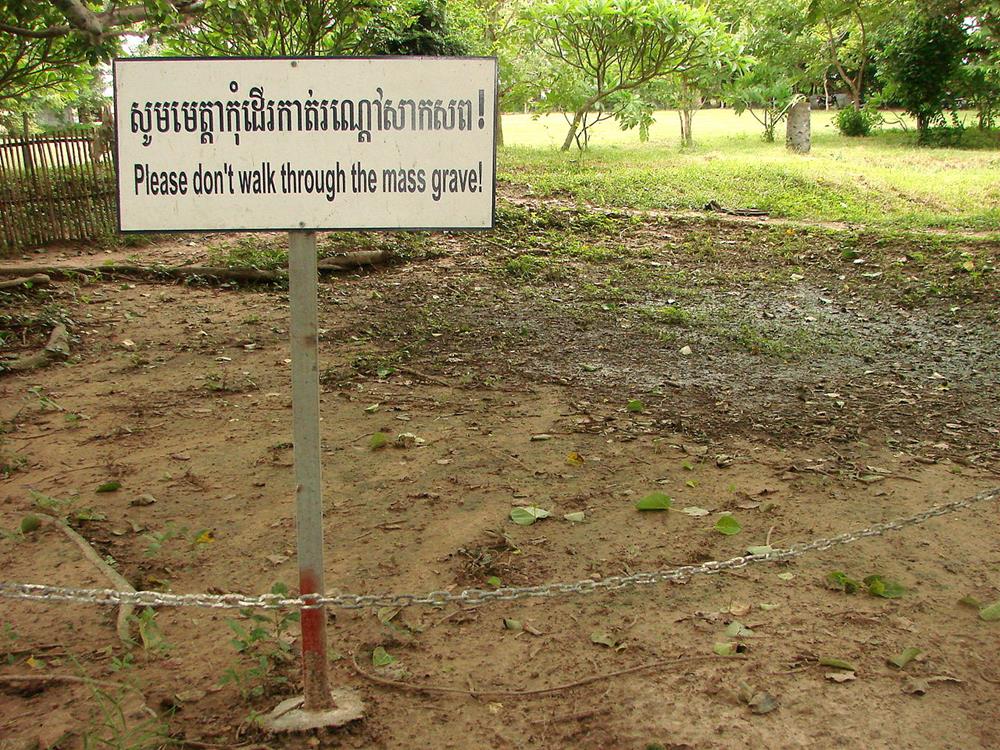
While Pol Pot’s agrarian reforms caused mass death through starvation and forced labor, the regime’s most calculated violence occurred in what came to be known as the Killing Fields. These execution sites, scattered across Cambodia, became the stage for the systematic murder of approximately 1.7 million people—nearly a quarter of the population.
The Khmer Rouge targeted intellectuals, professionals, religious figures, and ethnic minorities, branding them “enemies of the revolution.” At Tuol Sleng prison (S-21) in Phnom Penh, more than 12,000 prisoners were tortured into confessing fabricated crimes before being executed. Victims were often beaten to death with farm tools to conserve bullets; their bodies were dumped into mass graves. Some were dismembered or mutilated—acts of deliberate psychological terror.
This extermination campaign was designed to create a “pure” revolutionary society by eliminating anyone perceived to threaten Khmer Rouge ideology. It remains one of the most chilling examples of state-orchestrated genocide in modern history.
Persecution of Ethnic and Religious Minorities
In pursuit of ethnic and cultural homogeneity, the Khmer Rouge unleashed targeted violence against Cambodia’s minority communities. Their genocidal agenda aimed to erase any identity that did not conform to their radical vision of a purified Khmer society.
This persecution unfolded in several devastating ways:
- Cham Muslims faced forced assimilation, mass relocations, and systematic executions. Estimates suggest that 100,000 to 500,000 were killed. Mosques were destroyed, and religious practices were strictly forbidden.
- Ethnic Vietnamese were deported or executed en masse, with between 150,000 and 300,000 victims. The Khmer Rouge viewed them as outsiders to be purged from Cambodian soil.
- The ethnic Chinese population endured economic and cultural erasure, losing their businesses, language rights, and lives. Approximately 100,000 to 300,000 Chinese Cambodians are estimated to have perished under the regime.
The Khmer Rouge’s efforts to dismantle religious and ethnic diversity further underscore the regime’s deeply rooted policy of ethnonationalist violence.
Psychological Warfare: Indoctrination and Thought Control
Beyond physical brutality, the Khmer Rouge engaged in sophisticated psychological warfare to erase identity and instill total obedience. Their declaration of “Year Zero” was not just a political reset but the foundation of a widespread campaign of mind control.
Children were systematically turned against their families, trained to report on parents for disloyalty or dissent. By dismantling familial bonds, the regime created a population loyal only to Angkar—the all-powerful, faceless authority that symbolized the Khmer Rouge state.
In labor camps, citizens were subjected to re-education, including sleep deprivation, forced confessions, and ideological indoctrination. Cultural heritage was annihilated: religion, holidays, traditional music, and personal belongings were banned. The goal was to replace all traces of Cambodia’s past with a new identity defined entirely by extreme communist orthodoxy.
Global Response: International Inaction During the Genocide
As Cambodia descended into genocide, the international community stood largely silent. The world’s failure to act allowed the Khmer Rouge to continue its atrocities without consequence.
Three primary factors contributed to this inaction:
- Cold War geopolitics: The United States, Soviet Union, and China prioritized strategic interests over human rights. Cambodia became a pawn in their ideological rivalry.
- UN recognition: The United Nations continued to recognize the Khmer Rouge as Cambodia’s legitimate government until 1982, despite mounting evidence of genocide.
- Reaction to Vietnamese intervention: When Vietnam invaded in 1979 and overthrew Pol Pot, many Western nations condemned Vietnam, focusing more on geopolitical alignment than on the liberation of Cambodian citizens.
This failure of global leadership allowed one of the worst genocides of the 20th century to unfold largely unchecked.
Legacy of Trauma: Cambodia’s Ongoing Recovery Decades Later

Although the Khmer Rouge fell in 1979, the legacy of their crimes continues to shape Cambodia’s national identity and collective memory. The estimated two million deaths left behind not only a demographic void but also deep generational trauma.
In the aftermath, survivors faced the monumental task of rebuilding both infrastructure and society. In Phnom Penh, places like Tuol Sleng have been preserved as memorial sites, though they also attract tourism—sometimes blurring the line between commemoration and commercialization.
The creation of the Extraordinary Chambers in the Courts of Cambodia (ECCC) sought to deliver justice, but the trials were lengthy, expensive, and reached only a handful of senior leaders. For many Cambodians, true healing remains elusive.
Yet remembrance endures. Through oral histories, museums, music, and education, the memory of the Khmer Rouge’s atrocities lives on—offering a vital record for new generations and a warning to the world of what happens when ideology overrides humanity.