

The China Relief Expedition of 1900 was a significant military campaign that saw the cooperation of eight nations, including the United States, in response to the Boxer Rebellion in China. This multinational effort aimed to protect foreign citizens and quell the uprising that threatened foreign interests and lives in China. The United States played a pivotal role in this mission, contributing troops and resources to the cause.
The Boxer Rebellion: A Nationalist Uprising

The Boxer Rebellion was driven by Chinese nationalists who sought to expel foreign influence from their country. Known as the “Boxers” or the “Fists of Righteous Harmony,” these groups launched violent attacks against foreigners and Chinese Christians. By June 1900, the situation in Beijing had become dire, with approximately 3,500 foreigners and Chinese Christians forced to seek refuge in the foreign legation compound—a fortified area where embassies and consulates were located.
U.S. Military Response
In response to the growing crisis, the United States dispatched troops from Manila, Philippines, to assist in the international relief effort. On July 7, 1900, the 9th Infantry and a detachment of U.S. Marines landed at the port of Taku in China. These American forces soon joined with troops from other nations in an assault on Tianjin, a key city on the route to Beijing. The city was captured on July 13, but not without cost—95 American soldiers were either wounded or killed in the process.
The March to Beijing
On August 4, 1900, an allied force of approximately 18,000 to 19,000 soldiers from multiple countries began their advance toward Beijing. The U.S. contribution to this force was around 2,500 men, led by Major General Adna R. Chaffee. The American contingent included:
- 9th Infantry
- 14th Infantry
- Elements of the 6th Cavalry
- 5th Artillery
- Marines
The allied forces engaged in several hard-fought battles during their march to Beijing, including the battles of Pei-tsang on August 5 and Yang-tsun on August 6, both of which resulted in victories for the coalition.
The Siege of Beijing and the Relief of the Legation
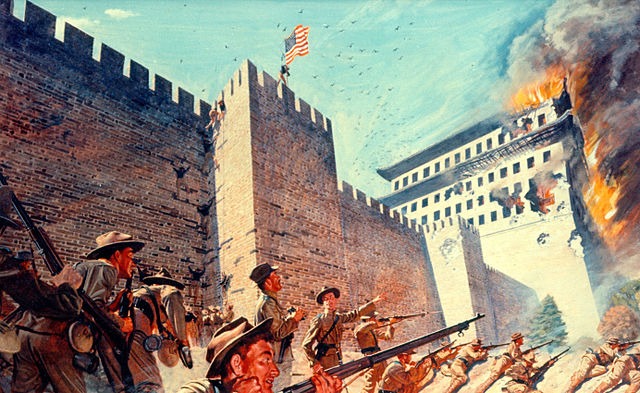
By August 14, 1900, the allied forces reached Beijing. The U.S. 14th Infantry distinguished itself by being the first to scale the Tartar Wall, hoisting the first foreign flag on the structure. This action played a crucial role in enabling British forces to reach and relieve the besieged legation compound. On the following day, Captain Henry J. Reilly’s Light Battery F of the 5th Artillery blasted open the gates to the Inner City, allowing American troops to enter and secure the area.
Aftermath and the Boxer Protocol
Following the successful relief of the legations, most U.S. troops returned to Manila before the onset of winter. However, a small contingent remained in China to help maintain order and to guard the U.S. Legation in Beijing.
The military campaign culminated in the signing of the Boxer Protocol on September 7, 1901. This agreement imposed several conditions on China, including:
- Establishment of a Protected Area: A designated zone around foreign embassies in Beijing was established to ensure their security.
- Foreign Military Presence: Foreign troops were authorized to guard the railway between Tianjin and Beijing, a vital transportation link.
- Financial Reparations: China was required to pay substantial reparations to the nations involved in the relief effort.
Interestingly, in 1908, the United States chose to return a portion of the reparations it had received from China. The refunded money was used by China to fund educational initiatives, demonstrating a diplomatic gesture of goodwill in the aftermath of the conflict.
Key Facts About the China Relief Expedition
- International Coalition: The China Relief Expedition involved troops from eight nations: the United States, Japan, Russia, Britain, France, Germany, Italy, and Austria-Hungary.
- Origins of the Boxer Rebellion: The uprising was fueled by anti-foreign and anti-Christian sentiments, with the Boxers seeking to rid China of foreign influence and control.
- Significant U.S. Participation: The U.S. contributed approximately 2,500 troops to the expedition, playing a key role in the relief of the besieged foreign legation in Beijing.
- Tianjin Battle: The capture of Tianjin on July 13, 1900, was a crucial victory for the allied forces, despite the heavy casualties suffered by the American contingent.
- March to Beijing: The march to Beijing was marked by fierce battles, including those at Pei-tsang and Yang-tsun, which were vital to the success of the expedition.
- Scaling the Tartar Wall: The U.S. 14th Infantry was the first to scale the Tartar Wall in Beijing, an action that proved pivotal in breaking the siege of the legation compound.
- Boxer Protocol: The Boxer Protocol of 1901 imposed significant penalties on China, including the establishment of a protected zone for foreign embassies and the payment of reparations.
- Post-Conflict Diplomacy: In 1908, the United States returned part of the reparations it received, which China used to fund educational programs, fostering improved relations between the two nations.
- Strategic Importance: The intervention highlighted the strategic importance of maintaining open trade routes and protecting foreign nationals in China during a time of significant internal unrest.
- Long-Term Impact: The Boxer Rebellion and the international response marked a turning point in China’s relations with the West, leading to further encroachments on Chinese sovereignty and contributing to the eventual downfall of the Qing Dynasty.