

Tsukahara Bokuden was one of the most formidable samurai of his time, known for defeating the best martial artists in Japan. He lived during the Muromachi Period and was the perfect example of a loyal, noble, and undefeated warrior in both battles for his lord and individual duels.
What’s particularly interesting about Bokuden is that later in life, he started to believe that avoiding conflict was more valuable than fighting and defeating an opponent. This idea, now expected in martial arts philosophy, was quite revolutionary in Bokuden’s era.
His philosophy of non-violence and mental clarity redefined how warriors approached combat, making him a seminal figure in kenjutsu. So, how exactly did Bokuden’s teachings and strategies leave an enduring impact on modern martial arts practices?
The Life and Works of Tsukahara Bokuden
Bokuden was born into the Yoshikawa family in the Hitachi Province of Honshu. His family was one of the four Karo families that served the Kashima clan, a branch of the Imperial House of Japan, descended from the Imperial Prince Kazurahara (786–853). The Tsukahara family, an offshoot of the Kashima clan, later adopted Bokuden. It immersed him in a rich martial arts tradition. Initially known as Tsukahara Shinemon Takamoto, he adopted the name Tsukahara Bokuden Takamoto, reflecting his ascension within the samurai class.
Guided by his adoptive father, Bokuden began rigorous training in Tenshin Shoden Katori Shinto-ryu, one of Japan’s oldest martial arts schools. He was focused on learning martial arts from a young age. The techniques and philosophies he absorbed would become fundamental to his teachings and contributions to martial arts.
Bokuden came from a noble lineage, being a descendant of Imperial Prince Kazurahara, which boosted his influence and status. As a wealthy nobleman, he often traveled with a full entourage and embodied the classic knight-errant. He systematized the local martial arts of the Kashima area, including combat techniques like Kashima no tachi and Ichi no tachi.
By the time he was 20, he faced his first big challenge. He bravely took on Ochiai Torazaemon, a famous warrior, and defeated him. While these duels could end in death, they didn’t always have to. In this case, Torazaemon was allowed to live. However, feeling humiliated, he tried to ambush Bokuden. Ultimately, Bokuden made a name for himself by defeating and killing the more experienced fighter.
Establishment of Kashima Shinto-ryu
Inspired by a divine vision from Takemikazuchi no kami, the deity of Kashima Shrine, Bokuden named his martial system Kashima Shinto-ryu. For a brief period, he also called his system Mutekatsu-ryu, which means “winning without hands.”
The “No Sword” School Incident
By the time Tsukahara Bokuden reached his 50s, he had developed a way of thinking ahead of its time. He became tired of constantly proving his skills, even though he was already extremely confident in them. He started to see more value in avoiding conflict rather than always having to prove himself as the best.
A famous story that inspired a scene in Bruce Lee’s movie Enter the Dragon illustrates Bokuden’s new perspective on non-violent solutions. While traveling on a ferry, a young samurai began bullying other passengers, boasting about his sword skills and claiming to be the best. When he noticed Bokuden’s calm demeanor, he angrily challenged the old master to a duel. Bokuden responded, “My art is different from yours. It focuses not so much on defeating others but on not being defeated.” He explained that his school was called Mutekatsu Ryu, meaning “to defeat an enemy without hands.”
The young samurai thought Bokuden was a coward and insisted on a fight, so they agreed to stop at a nearby island. However, when the young man jumped into the shallow waters to reach the island, Bokuden took the boatman’s pole and steered the boat back into deeper waters, leaving the young samurai stranded. Bokuden then laughed and shouted, “Here is my no sword school!”
Fictional Encounter with Miyamoto Musashi
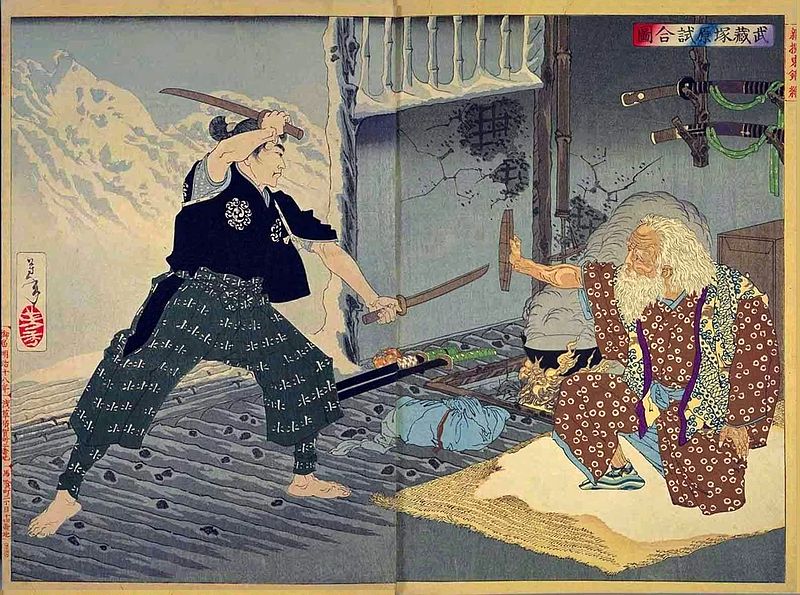
There is also a fictional story in which the young Miyamoto Musashi once challenged Bokuden to a duel during a meal. According to the tale, when Musashi attacked, Bokuden used the potlid from their meal as a shield to parry the blow. However, this story is purely mythical, as Bokuden died in 1571, thirteen years before Musashi was born in 1584.
Becoming a Samurai Legend
With special permission from his Daimyo, Bokuden went on a pilgrimage called Musha Shugyo to learn from the best teachers and challenge the top samurai warriors in Japan. He faced thirty-seven duels against the best fighters and defeated them all, paving his way to becoming a samurai legend.
After completing his pilgrimage, Bokuden returned to serve his Daimyo and continued to fight in his army. At 37, he retired from active service and established his own samurai school, the Shinto Ryu. There, he honed his skills and developed his unique style, the Single Cut Style.
According to modern Japanese author and martial arts practitioner Tokitsu Kenji, Bokuden fought his first duel to the death at 17. Throughout his life, he participated in 19 duels and 37 battles, being wounded six times but only by arrows. His death toll is estimated at 212 kills.
Retirement and Death
After retiring, Bokuden, a living legend, moved to a mountain sanctuary where many young samurai came to learn from him. He later went on a second pilgrimage, this time to teach rather than challenge other samurai. His most famous student during this period was the 17-year-old Shogun Ashikaga Yoshiteru, who studied martial arts with Bokuden in 1552.
In 1571, at the age of 83, the great samurai legend Tsukahara Bokuden passed away. His time was marked by civil strife, and many of the era’s best fighters died young in wars for their Daimyo, leading to the decline of many great schools, including Bokuden’s.
Despite living in turbulent times, Tsukahara Bokuden developed a peaceful philosophy, believing it was better to avoid conflict than to win a fight. This belief was echoed by many great martial arts masters who followed, such as Jigoro Kano, the founder of Judo, and Gichin Funakoshi, the founder of Shotokan karate. Bokuden’s forward-thinking approach cemented his place as a legendary figure in samurai history.
Tsukahara Bokuden in Pop Culture
One of the most famous examples of Bokuden’s influence in pop culture is Bruce Lee’s iconic movie Enter the Dragon. A scene where Bruce Lee teaches a bully a lesson about “fighting without fighting” is directly inspired by a story about Bokuden. In this story, Bokuden tricks a young samurai into thinking they will duel on an island, only to leave him stranded. This clever and peaceful approach to conflict resolution highlights Bokuden’s philosophy and has become a memorable moment in martial arts cinema.
Bokuden’s life has particularly inspired the character Gorobei, who appears in various narratives and films. These depictions capture his strategic brilliance and martial prowess.
Traditional Art
Bokuden also appears in various Japanese media, including ukiyo-e prints, which are traditional Japanese woodblock prints. One such print by Yoshitoshi depicts a fictional encounter between Bokuden and the legendary swordsman, Miyamoto Musashi. Although this meeting never happened, it shows how Bokuden’s legacy has been woven into the fabric of Japanese folklore.
Literature
Tsukahara Bokuden’s life and teachings have been the subject of numerous books and stories. These works delve into his innovative approach to swordsmanship and his philosophy of avoiding unnecessary conflict. Some notable books and stories include:
- The Sword of No-Sword: Life of the Master Warrior by John Stevens
- Legends of the Samurai by Hiroaki Sato
- The Book of Five Rings by Miyamoto Musashi (mentions and comparisons)
- Various Japanese historical novels and manga that explore the lives of samurai and their martial philosophies
Video Games
Tsukahara Bokuden has also appeared in video games, bringing his legendary status to a new generation. Some of the video games that feature Bokuden or characters inspired by him include:
- Samurai Warriors series (where he appears as a playable character)
- Nioh series (where he appears as a combat teacher the players must beat to unlock new skill tiers)
- Total War: Shogun 2 (which features various famous samurai, including references to their historical influence)
Conclusion
Tsukahara Bokuden profoundly influenced Japanese swordsmanship through his systematic approach to martial arts and the founding of Kashima Shinto-ryu. By integrating physical skill with spiritual discipline, he advanced the non-conflict and mental clarity philosophy, reshaping martial arts to emphasize respect and strategy. His legacy endures in modern kenjutsu, inspiring martial artists today. Bokuden’s teachings highlight that true mastery involves both skill and wisdom, leaving a lasting impact on the world of martial arts.